
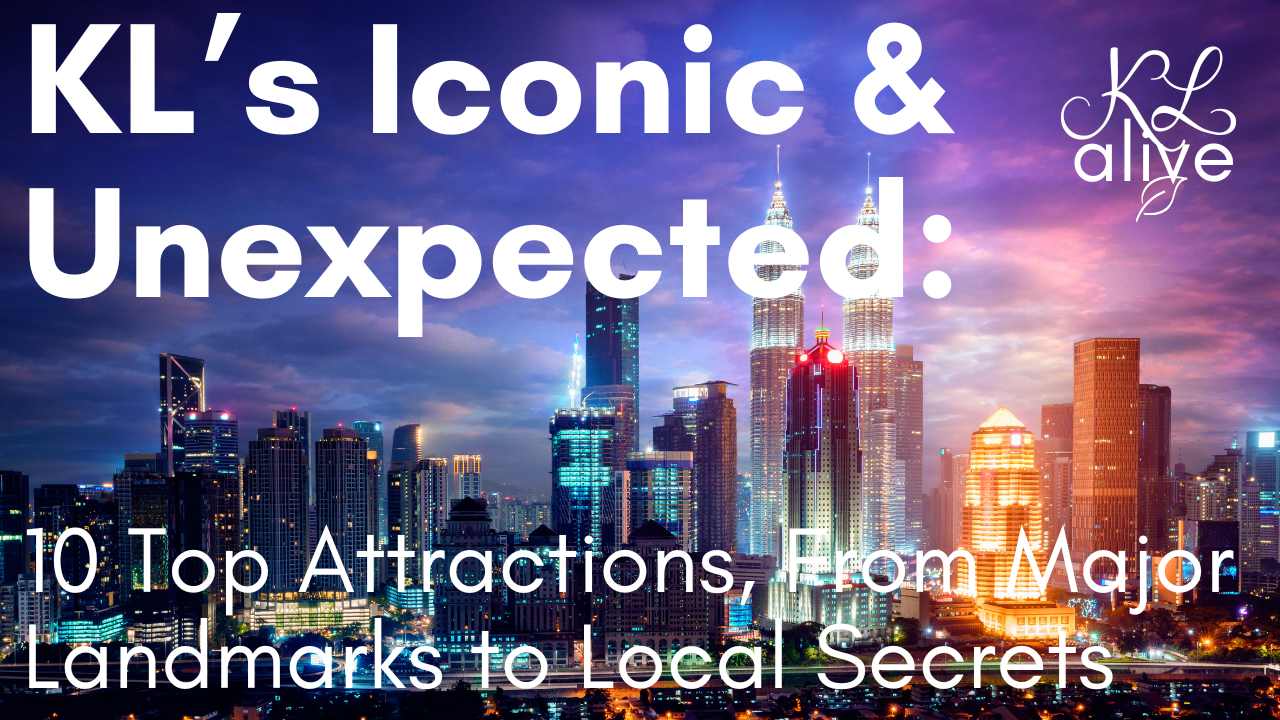
KL’s Iconic & Unexpected: 10 Top Attractions, From Major Landmarks to Local Secrets

1. Petronas Twin Towers
Standing at 452 meters, the Petronas Twin Towers are not just Kuala Lumpur's most iconic landmark but were also the world's tallest buildings from 1998 to 2004.
Designed by Argentine architect César Pelli, their distinctive postmodern style is inspired by Islamic geometric patterns, reflecting Malaysia's cultural heritage.
The towers are connected by the double-decker Skybridge on the 41st and 42nd floors, a masterpiece of engineering that allows for movement and stability.
A visit typically involves a tour to the Skybridge and the observation deck on the 86th floor, offering breathtaking panoramic views of the city's sprawling skyline.
Beneath the towers lies the upmarket Suria KLCC shopping mall, while the surrounding KLCC Park provides a 50-acre green lung with a symphony lake and fountain show.
The towers are a symbol of Malaysia's rapid economic growth and ambition.
Interestingly, the construction involved a fierce competition between Japanese and South Korean consortia.
The concrete used is a specific high-grade mix to withstand regional seismic activity.
Securing tickets in advance is crucial due to high demand, with timed entries strictly enforced.
At night, the towers are illuminated, creating a dazzling spectacle that defines the city's image globally.
2. Batu Caves
Located just 13 kilometers north of Kuala Lumpur, the Batu Caves are a monumental limestone hill housing a series of caves and cave temples.
As one of the most popular Hindu shrines outside India, it is dedicated to Lord Murugan.
The site is dominated by the towering, 42.7-meter-high golden statue of Murugan and the 272 brightly colored steps leading to the main Temple Cave (Cathedral Cave).
The caves are approximately 400 million years old and were used as shelters by the indigenous Temuan people before being promoted as a place of worship by Indian trader K. Thamboosamy Pillai in the late 19th century.
The site is most vibrant during the annual Thaipusam festival, when over a million devotees and spectators gather for a procession of piercing, kavadis (ornate burdens), and spiritual rituals.
Besides the main cave, the complex includes the Dark Cave, a conservation area for specialized fauna like cave crickets and rare spiders, accessible via educational tours, and the Ramayana Cave at the base, depicting the Hindu epic through vivid dioramas.
Visitors should dress modestly, be prepared for steep climbs, and be wary of the numerous long-tailed macaques.
The recent renovation of the steps into a vibrant rainbow staircase has made it an even more photogenic global attraction.
Hubs for KL Alive's Web Properties
KL Alive Website | Digital Brochure | Instagram | Facebook | X (Twitter) | TikTok | Pinterest |
3. Merdeka Square (Dataran Merdeka)
Merdeka Square is the historic heart of Kuala Lumpur, where the Malayan flag was first raised at midnight on August 31, 1957, marking independence from British rule.
The large, open field is surrounded by some of the city's most significant colonial-era buildings, creating a vivid architectural timeline.
These include the Sultan Abdul Samad Building, with its distinctive copper domes and 41-meter clock tower (a Moorish-style former government secretariat), the Royal Selangor Club (resembling a Tudor-style manor), and St. Mary's Anglican Cathedral.
The square itself holds the world's tallest flagpole at 95 meters, flying a massive Malaysian flag.
Beneath the field is an underground parking lot and the Plaza Putra, a food and leisure complex.
The square is a focal point for national celebrations like Merdeka Day and New Year's Eve.
It is also the starting point for many city tours, offering a tangible connection to the nation's journey from colonialism to independence.
The surrounding area is pedestrian-friendly, with informational plaques detailing the historical significance of each building, making it an essential visit for understanding Kuala Lumpur's origins and symbolic core.
4. Thean Hou Temple
Perched on a hill overlooking the city, the Thean Hou Temple is a magnificent six-tiered Chinese temple dedicated to the Heavenly Queen (Mazu), the Taoist goddess of seafarers.
Operated by the Selangor and Federal Territory Hainan Association, it was completed in 1989 and is an exemplary model of modern Chinese temple architecture, blending elements of Confucianism, Taoism, and Buddhism.
Its design incorporates symbolic motifs for prosperity, longevity, and harmony, with ornate dragon pillars, intricate carvings, and sweeping roofs.
The temple is not only a religious site but also a cultural and community center.
It features a marriage registration office, a medicinal herb garden, a wishing well, and shrines to other deities like Guan Yin (Goddess of Mercy).
During major festivals like Chinese New Year and Mid-Autumn Festival, the temple is spectacularly decorated and draws thousands of devotees.
Its elevated courtyard offers serene views of the Klang Valley, and the open-air design promotes tranquility.
The temple's harmonious architecture and its role in serving the community make it a key site for experiencing the depth of Malaysian Chinese culture and religious pluralism in Kuala Lumpur.

Giap One Biz & Brands:
I am Giap, the founder of this website, KL Alive.
KL Alive is one of Giap One's focused biz and brands:
• Qdigital: Digital Marketing
• KL Alive: Kuala Lumpur Travel Guide
• WhaleBuy Digital: E-Commerce Go Online+Offline
•
5. Perdana Botanical Garden (Lake Gardens)
Established in 1888 by British State Treasurer Alfred Venning, the Perdana Botanical Garden (formerly Lake Gardens) is Kuala Lumpur's oldest and most extensive green space, covering over 226 acres.
It serves as a vital ecological lung in the city center, designed as a classic English landscape garden with rolling lawns, artificial lakes, and curated plant collections.
The garden is actually an umbrella precinct for several major attractions, including the KL Bird Park (the world's largest free-flight walk-in aviary), the Hibiscus and Orchid Gardens, the Deer Park, and the Islamic Arts Museum Malaysia.
The centerpiece is the newly renovated Botanical Garden section, which features a canopy walk, a sunken garden, and dedicated collections of palms, ferns, and gingers.
It's a haven for birdwatchers, joggers, and families seeking respite from the urban bustle.
The gardens reflect the colonial history of creating "civilized" recreational spaces, which have since been transformed and expanded for public use.
Its location near key landmarks like the National Mosque and Old Railway Station makes it a perfect stop on a cultural and nature-themed itinerary, showcasing Malaysia's biodiversity in a meticulously maintained setting.
6. Islamic Arts Museum Malaysia (IAMM)
Housed in a purpose-built, modern building with a stunning turquoise dome near the Perdana Botanical Garden, the Islamic Arts Museum Malaysia (IAMM) is Southeast Asia's largest museum dedicated to Islamic art.
It opened in 1998 and boasts a world-class collection of over 7,000 artifacts from across the Islamic world, spanning from the 7th century to the present day.
The museum's mission is to showcase the diversity and craftsmanship of Islamic civilization beyond the Middle East, with significant galleries dedicated to India, China, and the Malay world.
The galleries are thematically organized, covering architecture, Qur'an and manuscripts, textiles, jewelry, arms and armor, and ceramics.
One of its most impressive displays is a large-scale architectural model collection of iconic mosques like the Al-Haram in Mecca and the Dome of the Rock in Jerusalem.
The museum also features a excellent conservation center, a specialized library, and a highly regarded restaurant serving Middle Eastern cuisine. Its educational approach, beautiful presentation, and focus on the global reach of Islamic art make it an indispensable cultural institution for both casual visitors and scholars, promoting a deeper understanding of Islamic heritage.
7. Central Market (Pasar Seni)
Central Market, or Pasar Seni, is a historic Art Deco building that began life in 1888 as a wet market.
It was rebuilt in its current form in 1937 and transformed into a cultural market in the 1980s, becoming a designated Heritage Site.
Today, it is the premier venue for Malaysian cultural goods and handicrafts, housing over 300 shops and stalls.
The market is meticulously organized into different sections, including the Main Arcade for souvenirs, the Annexe for contemporary art and indie culture, and the Kasturi Walk for food and outdoor performances.
It serves as a crucial platform for local artisans to sell traditional items such as batik clothing, songket fabric, pewterware, wooden carvings, and local art.
The building itself is a cultural artifact, with murals and installations depicting Malaysian life.
The Central Market is more than a tourist bazaar; it is an active effort to preserve and commercialize traditional crafts in a modern economy.
Its location near the Klang River and within walking distance of Chinatown makes it a bustling hub.
The daily cultural performances and workshops further enhance its role as a living museum of Malaysian arts and culture.
8. Jalan Alor
Jalan Alor is Kuala Lumpur's quintessential street food paradise.
By day, it is a relatively quiet backstreet in the Bukit Bintang entertainment district, but as dusk falls, it transforms into a bustling, neon-lit open-air dining spectacle.
Spanning about 500 meters, the street is lined with dozens of hawker stalls and open-air restaurants, with tables and chairs spilling onto the road, which is closed to through traffic in the evening.
It gained prominence in the 1970s as a focal point for cheap, delicious food after the closure of other street food areas.
The offering is a glorious mix of Malaysian Chinese cuisine, with iconic dishes like grilled chicken wings, chili crab, stir-fried *kway teow*, satay, *hokkien mee*, and roasted meats.
It also features fresh seafood, tropical fruits, and local desserts like *cendol* and ais kacang.
Jalan Alor provides an authentic, sensory-rich experience of Malaysia's famed food culture in a democratic, informal setting.
While it is firmly on the tourist trail, it remains popular with locals for late-night suppers, retaining its vibrant, chaotic charm.
It represents the survival of traditional street food culture amidst the city's rapid modernization and gentrification.
9. National Museum of Malaysia (Muzium Negara)
The Muzium Negara is the nation's premier history and ethnology museum.
Opened in 1963 on the site of the former Selangor Museum (destroyed in WWII), its distinctive Minangkabau-style *rumah gadang* roof design immediately signals its role as a keeper of Malay heritage.
The museum's core narrative is presented across four main galleries, tracing the peninsula's history from prehistoric times through the ancient Malay kingdoms, the colonial era, and up to post-independence Malaysia.
Key artifacts include the 11,000-year-old Perak Man skeleton, replicas of royal regalia from Malay sultanates, dioramas depicting historical events, and exhibits on traditional lifestyles and cultural practices of Malaysia's diverse ethnic groups.
The museum grounds also feature outdoor displays of vintage vehicles, historical locomotives, and reconstructed traditional houses.
While some exhibits appear dated, the museum provides a fundamental, chronological framework for understanding the country's complex past. It is an essential first stop for any visitor seeking context for the nation's multicultural society, political structure, and economic development, serving as a foundational educational institution.
10. KL Forest Eco Park (Bukit Nanas Forest Reserve)
The KL Forest Eco Park is a remarkable 10.5-hectare tract of pristine lowland dipterocarp rainforest, preserved within the city's Golden Triangle.
Established as a forest reserve in 1906, it is one of the oldest permanent forest reserves in Malaysia, predating the city's rapid development.
It offers a unique opportunity to experience primary rainforest flora and fauna—including monkeys, squirrels, and numerous bird species—just minutes away from skyscrapers like the Petronas Towers.
The park's main attraction is the 200-meter-long canopy walkway, suspended 15 meters above the forest floor, which allows visitors to observe the ecosystem at tree-canopy level.
Well-marked trails wind through the dense vegetation, with informational signs identifying plant species.
The park functions as a critical green lung, a biodiversity reservoir, and a natural laboratory for environmental education.
Its existence is a testament to early conservation efforts and provides a stark, valuable contrast between natural heritage and urban development.
It is a popular spot for morning exercise, bird watching, and a quick, refreshing escape into nature without leaving the city limits.



How I Build KL Alive Business with AI, Thrive Theme, Canva, Obsidian.




Getting To Know Giap • The Founder of Cancer Fight Funds


